How Your Body was Designed to Clean House: Understanding and Supporting Your Liver’s Three-Phase Detox System
Making Sense of “Detox”
If you’ve been living with fatigue, headaches, brain fog, skin flare-ups, or a body that seems to react to everything, you’ve probably been told you need to “detox” more times than you can count. Baths, saunas, juice cleanses, foot pads, teas, three-day resets—the list goes on. Maybe you’ve even tried a few, only to feel worse instead of better.
It is important to understand that detoxification is a process, not a product. It’s part of the way God designed your body to care for itself, with your liver playing a central role.
Think of this process as an assembly line with three coordinated phases. Each phase has a specific job, and each depends on the others to keep things moving. When I sit down with a new patient, I’m often looking for places where that process may have slowed down or backed up. Is the body missing nutrients it needs? Is it dealing with more exposure to harmful substances than it can easily handle?
The goal isn’t simply to push the body to “detox more.” It’s to understand what may be getting in the way, ease that burden, and support the work the body was designed to do.
In this post, I’ll walk you through each phase in plain language—what it does, what it needs to work well, and what can get in the way.
The big picture: Helping “oily” substances leave the body
Oil and water don’t mix. That simple idea helps explain an important part of how your body processes and removes certain substances.
Some chemicals we encounter- including certain pesticides, chemicals used in plastics, fragrance ingredients, and mold toxins called mycotoxins—are fat-soluble, meaning they dissolve more easily in fat than in water. Many medications and some of the hormones your body naturally produces also share this characteristic. Medications and hormones aren’t automatically “toxins,” but your body still needs to process them once they’ve done their job. Left alone, they can influence tissue throughout the body including the brain and nervous system.
Because these substances don’t dissolve easily in water, your kidneys generally can’t remove them efficiently in urine without some help. Your liver helps by changing their chemical structure, often making them easier to dissolve in water and eliminate- we call this ‘water soluble’.
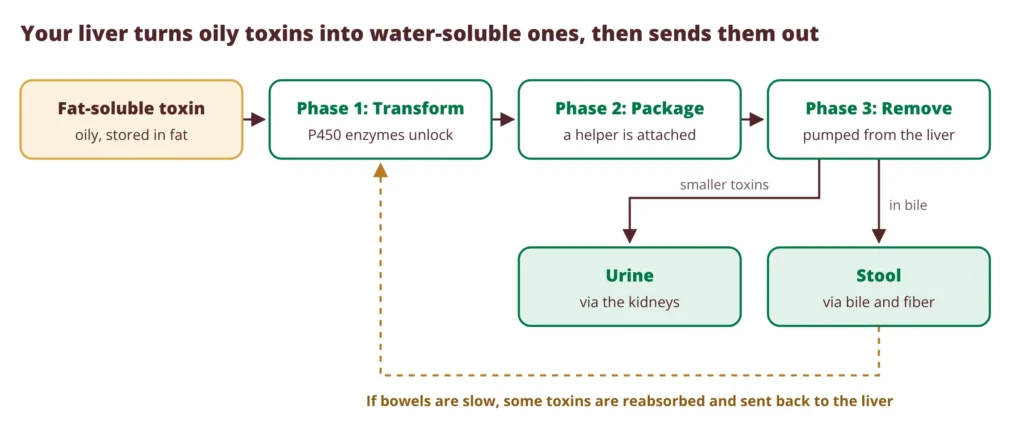
For this blog, we’ll describe that work in three phases:
- Phase 1 — Transform: Enzymes, the body’s tiny chemical workers, change the substance’s structure to prepare it for further processing.
- Phase 2 — Package: The body attaches another molecule to the substance. Think of adding a handle that makes it easier to carry away. This usually makes the substance more water-soluble and easier to eliminate.
- Phase 3 — Remove: Transport proteins help move the processed substances out of cells. They can then leave through the kidneys in urine or enter bile—a digestive fluid made by the liver—and pass into the intestines for removal in stool.
Think of it as a waste-processing system: Phase 1 prepares an item, Phase 2 packages it, and Phase 3 moves it out. It’s a helpful picture, although the body doesn’t always follow these steps in order. Some substances can go straight to Phase 2.
The goal is coordination, not simply making one phase work faster.
Phase 1: Transform—Preparing for the next step
This is your first line of defense against toxins. Phase 1 is activated by many external toxins. Examples include caffeine, alcohol, dioxin, paint fumes, steroids, pesticides, sleeping pills, contraceptive pills and cortisone. Phase 1 changes a substance’s chemical structure. Much of this work is done by a family of enzymes called cytochrome P450, often shortened to CYP450. These enzymes are especially important in the liver, although they also work in other parts of the body. Other enzymes help with Phase 1, too.
I like to think of these enzymes as a preparation crew. They make small changes that can help the body handle a substance or prepare it for the next phase.
Those changes happen through three main types of chemical reactions:
- Oxidation: Often adds oxygen or removes hydrogen, changing how the substance behaves. This is the most common type of Phase 1 reaction.
- Reduction: Changes the substance by adding electrons—tiny particles involved in chemical reactions.
- Hydrolysis: Uses water to break a chemical bond, splitting the substance into smaller parts. “Hydro” means water, and “lysis” means splitting.
You don’t need to memorize chemistry. The important point is that these reactions can create or uncover an attachment point that Phase 2 can use making the substance ‘water soluble’.
Why the next step matters.
Changing a substance doesn’t always make it harmless right away.
The newly formed substance is called a metabolite—simply a product of the body’s processing work. Some metabolites are less active than the original substance. Others remain active, and some are more reactive and potentially harmful. Certain Phase 1 reactions can also produce free radicals, unstable molecules that can contribute to cell damage if the body’s protective systems don’t keep them in check.
That’s why “speeding up detox” isn’t necessarily the goal. The body needs to process and remove these substances while managing any reactive byproducts along the way. If Phase 1 runs too fast, and Phase 2 cannot keep up, then there is the risk of intermediate metabolites accumulating that could lead to damaged cells, DNA, and tissues.
What Phase 1 needs to work well
Your liver needs nourishment to do its everyday work, so nutrients that help build the enzymes and drive chemical reactions are very important.
- B vitamins: Riboflavin (B2), Niacin (B3), Pyroxine (B6), Methylcobalamin (B12), and folate (B9)
- Iron: keep it in healthy balance, since P450 enzymes need Iron (heme) to bind and activate oxygen
- Protein: provides the amino acids that build the enzymes
- Antioxidants: quench the free radicals Phase 1 creates- vitamin C, vitamin E, selenium, CoQ10, and colorful plant compounds (flavonoids)
- Glutathione: a naturally made antioxidant that protects cells and supports the body’s detoxification processes
Food comes first in my practice. Rather than focusing on a single “detox food,” I encourage patients to build meals around adequate protein and a variety of vegetables, fruits, and other nutrient-rich foods.
I ask patients to be mindful of consuming foods that stimulate liver function and bile flow. I present them as foods—not as a cleanse or a guaranteed way to increase detoxification.
- Herbs: milk thistle, sassafras, caraway, burdock, dandelion, rosemary and dill
- Citrus: lemon, limes, tangerines and oranges (grapefruit shuts down Phase 1)
- Crucifer veggies: broccoli, brussels sprouts, cabbage, cauliflower, artichoke, leeks, asparagus
When I consider additional support, it becomes an individualized plan. That may include discussing nutrients/supplements. I don’t recommend them as a standard “detox stack” for everyone.
- Lipotropics: compounds that breakdown fat in metabolism (cysteine, methionine, choline, and inositol)
- N-acetylcysteine (NAC)
- Glutathione
- Alpha-lipoic acid
- Milk thistle
- Taurine.
What can change Phase 1 activity?
Phase 1 isn’t a single switch that is either on or off. It involves many enzymes, and a substance may speed up one enzyme while slowing another. The effect also depends on which medication or chemical the body is processing.
Factors to consider include:
- Nutrient deficiencies, especially low B vitamins or inadequate protein
- Upregulated (induced) Phase 1: smoking, alcohol, charred or grilled meats, and heavy chemical exposure can speed up certain P450 enzymes, producing more intermediate metabolites than Phase 2 can neutralize
- Downregulated (inhibited) Phase 1: grapefruit, some medications, and aging can slow certain P450 enzymes, so toxins remain in circulation longer
- Genetics: small variations in P450 genes help explain why two people react so differently to the same medication or exposure
- Toxic overload: when exposure to mold, heavy metals, and chronic infections exceeds what the liver can process, these compounds compete for the same enzymes and the system becomes overburdened.
- Overall health and nutrition: Liver function, age, and nutritional status can influence how the body processes medications and other substances. These factors need to be considered together rather than assuming that symptoms point to one blocked pathway.
In practice, I look at the whole picture: nutrition, medications, supplements, relevant exposures, and underlying health conditions. The aim is to understand what needs attention—not to push the liver to work harder.
Phase 2: Package—Preparing substances to leave
In Phase 2, the liver attaches a “helper” molecule to the substance being processed. This step, called conjugation, usually makes the substance less reactive and easier to dissolve in water, helping the body remove it. Think of Phase 2 as a packaging station with six different pathways to take water soluble Phase 1 metabolites out of your body through your bile, urine and stool. Each uses a different helper molecule to prepare certain substances for removal.
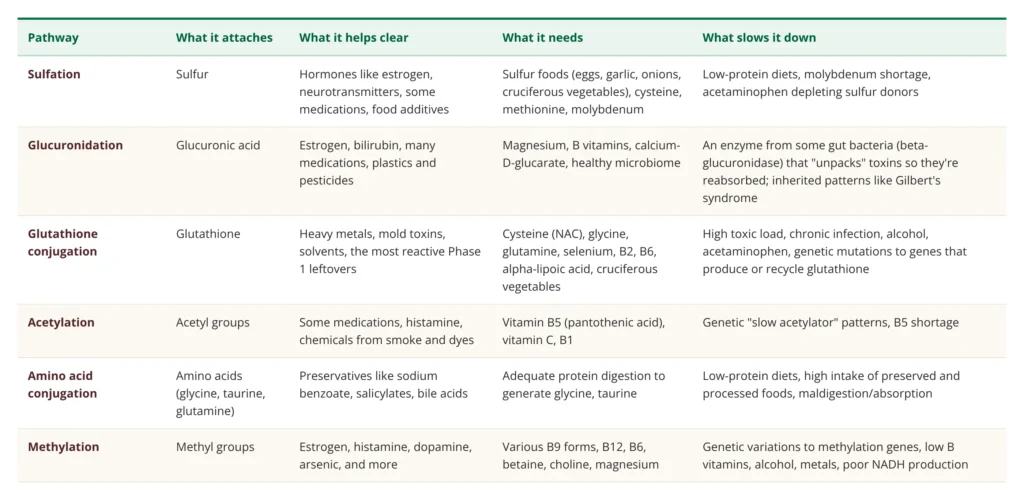
If even one of these pathways is impaired – nutritional deficiency, genetic variation, overwhelming toxic load – then the compounds that depend on it for clearance can begin to accumulate in the body.
A few things I discuss with patients when supporting Phase 2:
- Epsom salt baths can move to help feed sulfation. Choose pure Epsom salt without added essential oils, scents, or additives. It is high in Mg and sulfur.
- Avoid Tylenol (acetaminophen). It interferes with glutathione levels, the master antioxidant that protects the liver and pulls metals and toxins out of the body. This is important because I find in practice that people with chronic health problems tend to have genetic mutations to genes that produce less or recycle less glutathione than those without chronic conditions.
- Skip folic acid. If you carry an MTHFR variation/’methylation defect’, the synthetic folic acid in fortified foods and vitamins can hamper the way the body is trying to methylate. The active forms: Folinic Acid, Methylfolate and methytetrahydrofolate are what the body’s chemistry prefers. It is rare that I see someone in my office these days that have a chronic condition without a SNP (single nucleic polymorphism) to a gene that supports methylation.
Phase 3: Remove—Taking out the trash
Preparing a substance for removal isn’t the same as getting it out of the body. That’s where Phase 3 comes in.
After the liver processes a substance, tiny transport proteins help move it out of the liver’s cells. Think of them as the cell’s exit doors. Many use energy to move processed substances in one of two directions: into the blood, where they can travel to the kidneys, or into bile, which carries them toward the intestines.
These transport systems are an important part of keeping things moving. When they are disrupted, certain substances can build up in liver cells or be redirected into the blood. The details depend on the substance and the transport system involved—it isn’t simply a matter of all “toxins” backing up in the same way.
From there, many processed substances leave through one of two main exits.
Exit 1: Urine
The kidneys remove many water-soluble waste products from the blood and send them out of the body in urine.
Drinking enough fluid helps your kidneys do their everyday work, but water alone doesn’t determine how well this exit functions. Kidney health and the way each substance is handled matter, too. Rather than thinking of water as a way to “flush out toxins,” think of hydration as supporting the system’s normal work.
Exit 2: Bile, then stool
Your liver makes bile, a fluid that helps you digest fats and carries certain waste products into the intestines. The gallbladder stores bile and releases it when you eat, particularly when a meal contains fat. Some of the substances carried in bile then leave the body in stool.
But this isn’t a one-way conveyor belt. Your body normally reabsorbs and reuses most of its bile acids—the components of bile that help digest fat. Some medications and other substances can also be reabsorbed and return to the liver. This liver–gut recycling loop is called enterohepatic circulation.
Regular, comfortable bowel movements are worth paying attention to. Constipation can mean hard stools, straining, a feeling of incomplete emptying, or skipping days.
Think of it this way: preparing and packaging the trash matters, but so does getting it out the door. Phase 3 is the transport-and-removal part of the process—not simply another step in changing the substance.
There is growing evidence suggesting some diseases are the direct result of damage to the body from poor Phase 2 detoxification. Some of the diseases that may be caused by toxic intermediate metabolites and free radicals include cancer, Parkinson’s disease, MS and immune dysfunction.
What your stool can tell you
Your bowel movements and the frequency of them are one of the simplest ways to see how well Phase 3 is working. Many providers use the Bristol Stool Chart, a 7-point scale of stool shape and consistency:
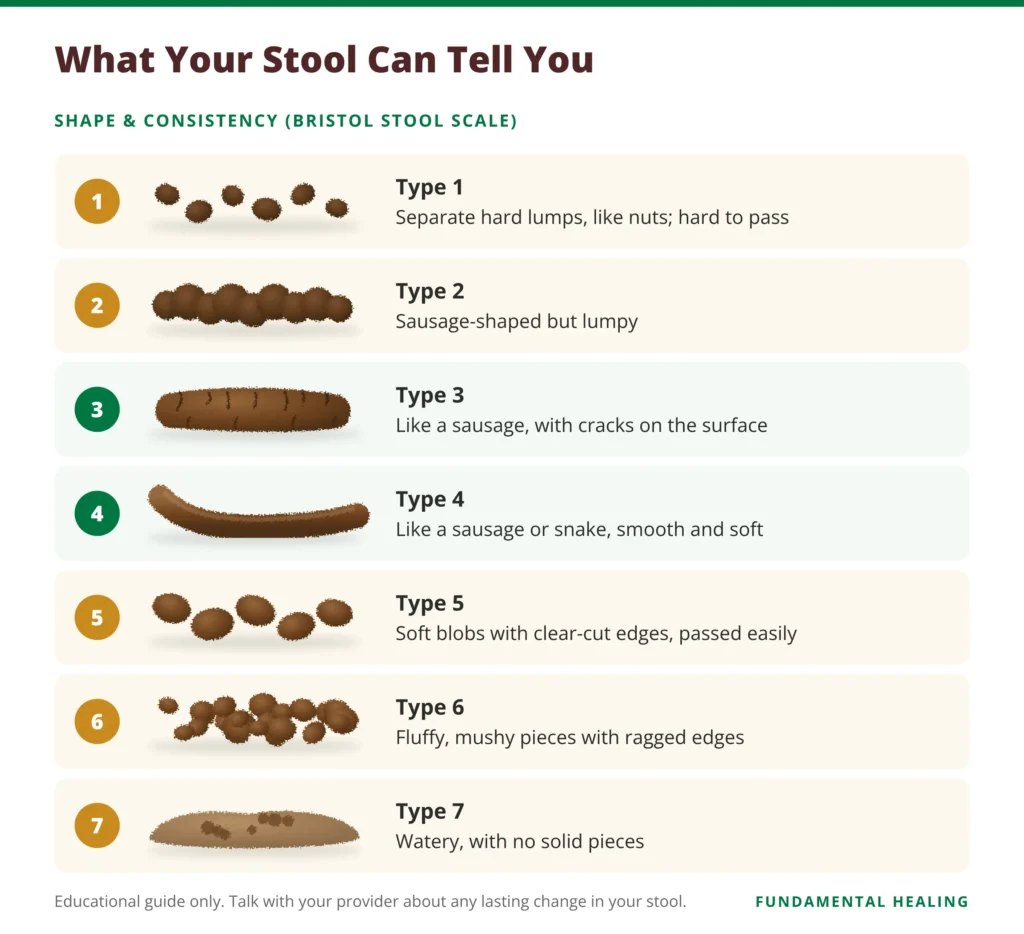
Color matters. Stool normally comes in a range of brown shades, thanks to pigments in bile that change color during digestion. Pale, clay-colored, or gray stool may mean too little bile is reaching the intestines and should be discussed with your healthcare provider. Green stool often comes from leafy greens or food moving through the intestines more quickly than usual. Red or black stool can sometimes be explained by foods such as beets, iron supplements, or medicines such as Pepto-Bismol—but it can also signal bleeding. If you notice unexplained red or black stool, especially black, tar-like stool, seek medical attention right away.
What keeps Phase 3 moving
- Hydration: Drink enough water throughout the day to stay hydrated and help keep stools soft. Water and other fluids help dietary fiber do its job
- Regular comfortable bowel movements: Include fiber-rich foods such as vegetables, fruit, beans, ground flaxseed, and chia seeds. Increase fiber gradually and drink enough fluid alongside it. The goal is stools that are easy to pass—not forcing a bowel movement every day. Walking and other regular physical activity can help keep the bowels moving
- Bile flow nutrients: good fats, bitter greens (arugula, dandelion), beets, taurine, phosphatidylcholine, Vitamin E and Tudca.
- Binders: when appropriate and dependent on the toxins you are attempting to bind and clear.
- A balanced gut: Some gut bacteria can “unpack” certain substances the liver has prepared for removal, allowing them to be reabsorbed. This is part of a complex recycling process—not simply a matter of “good” versus “bad” bacteria
In my practice, I also like to encourage:
- Clean water, and plenty of it: about half your body weight in ounces each day, ideally reverse osmosis filtered with some minerals added back in to support absorption.
- Celery juice: 20 ounces of fresh organic celery juice daily for 30 days is a wonderful liver cleanse with gentle diuretic properties
- Lymphatic drainage massage: Connecting with a certified Cranial Sacral Therapist to help move lymph that is stagnant.
- Castor Oil Packs: Three days on, two days off over the liver for reducing congestion.
- Homeopathy: Supporting the body to move toxins.
- A man-made zeolite that is consistent in size: Advanced TRS has been used in my practice since 2015. I introduce it slowly when the body is ready, because starting too much too soon can trigger a healing crisis.
What can interfere with Phase 3?
- Constipation: Makes it harder to pass stool and the waste it contains.
- Dehydration: Can contribute to hard stools and constipation.
- Problems with bile flow: Gallstones or other conditions can interfere with bile reaching the intestines. Very low-fat diets or long periods without eating may also reduce gallbladder emptying.
- Changes in gut bacteria: Some bacteria can “unpack” certain substances the liver has prepared for removal, allowing them to be reabsorbed rather than leave in stool
Why I start with the exits
Before adding anything intended to support detoxification, I look at the basics: Are you staying hydrated? Are your bowel movements comfortable and regular? Are there digestive symptoms or signs of a liver or gallbladder problem that need attention?
A store-bought “detox” can leave you feeling worse, but that doesn’t necessarily mean it’s working. Detox programs have limited evidence behind them, and restrictive diets or certain products can cause side effects. Headaches, fatigue, or other new symptoms shouldn’t automatically be dismissed as a sign that toxins are leaving your body.
In my practice, I use an “exits first” approach to organize care:
- Start with elimination. Address constipation, support adequate hydration, and evaluate concerns about bile flow rather than assuming a cleanse will fix them.
- Build a nutritional foundation. Make sure you’re getting enough food, protein, and the nutrients your body needs to process substances and maintain its protective systems.
- Reduce avoidable exposures. Review relevant environmental exposures, medications, and supplements, then consider whether additional, targeted support is appropriate. Reducing harmful exposures doesn’t have to wait until the other steps are complete.
This is a framework for care—not a way to switch the liver’s phases on and off. The goal is support, not forcing the body to “detox harder.”
No two people have the same needs. Your health history, symptoms, nutrition, medications, and potential exposures help guide the plan. That’s why I take time to hear your full story and, when appropriate, use targeted testing to investigate specific concerns. Rather than assuming everyone has the same “bottleneck,” I look for identifiable issues we can address together.
Simple ways to start supporting your liver today
- Stay hydrated. Drink good reverse osmosis or distilled water regularly with minerals, throughout the day.
- Include a cruciferous vegetable daily. Broccoli, cauliflower, cabbage, and Brussels sprouts are good options.
- Include clean protein at every meal- lean and rinsed well before cooking. Choose options such as fish, poultry, eggs, beans, lentils, bison.
- Add color to your plate. Mix in berries, beets, leafy greens, and a variety of other fruits and vegetables.
- Support regular, comfortable bowel movements. Focus on fiber, fluids, and movement rather than forcing a daily schedule. If you struggle to get in your steps, a vibration plate can prove to be very helpful for the right person.
- Reduce avoidable exposures. Take a closer look at your personal care products, household cleaners, and food-storage habits. My Home Safe Haven Guide offers ideas for getting started.
- Make time for rest. Give yourself a consistent bedtime and room in your schedule for restorative sleep. Much of your body’s repair work happens during deep sleep.
You don’t have to change everything at once. Start with one or two habits you can maintain, then build from there.
Your body was designed to heal
During my own healing journey—and later, my children’s—learning about these pathways changed how I understood what we were experiencing. Symptoms that once felt disconnected began to fit into a bigger picture, helping us ask better questions and take more informed steps forward.
Psalm 139 reminds us that we are “fearfully and wonderfully made.” To me, the body’s intricate systems for processing and removing waste are part of that remarkable design.
Your liver doesn’t need to be forced or flushed. Supporting it starts with nourishment, healthy daily habits, and attention to any medical concerns that need care. The goal isn’t to push your body harder. It’s to care for it well and support the work it is already doing.
If you’ve been feeling worn down, reacting to seemingly everything, or wondering why you still don’t feel like yourself, you deserve to feel heard. I’d love to listen to your story and explore what may be contributing to your symptoms. Reach out to schedule a consultation, and let’s take the next step together.
This article is for educational purposes and isn’t a substitute for personalized medical care. Please talk with your provider before starting new supplements, especially if you’re pregnant, nursing, or taking medications.
References
- Hodges RE, Minich DM. Modulation of metabolic detoxification pathways using foods and food-derived components: a scientific review with clinical application. Journal of Nutrition and Metabolism. 2015;2015:760689. doi:10.1155/2015/760689.onlinelibrary.wiley
- Liska DJ. The detoxification enzyme systems. Alternative Medicine Review. 1998;3(3):187–198.
- Grant DM. Detoxification pathways in the liver. Journal of Inherited Metabolic Disease. 1991;14(4):421–430.
- U.S. Food and Drug Administration. Grapefruit juice and some drugs don’t mix. Accessed October 25, 2026. https://www.fda.gov/consumers/consumer-updates/grapefruit-juice-and-some-drugs-dont-mixfda
- National Center for Complementary and Integrative Health. Milk thistle: usefulness and safety. National Institutes of Health. Accessed October 25, 2026. https://www.nccih.nih.gov/health/milk-thistlenccih.nih
- Gao S, Sun R, Singh R, et al. The role of gut microbial beta-glucuronidases (gmGUS) in drug disposition and development. Drug Discovery Today. 2022;27(10):103316. doi:10.1016/j.drudis.2022.07.001.pmc.ncbi.nlm.nih
- U.S. Food and Drug Administration. Acetaminophen. Accessed October 25, 2026. https://www.fda.gov/drugs/safe-use-over-counter-pain-relievers-and-fever-reducers/acetaminophenfda
- Centers for Disease Control and Prevention. MTHFR gene variant and folic acid facts. July 16, 2026. Accessed October 25, 2026. https://www.cdc.gov/folic-acid/data-research/mthfr/index.htmlcdc
- National Institute of Diabetes and Digestive and Kidney Diseases. Your kidneys & how they work. National Institutes of Health. Accessed October 25, 2026. https://www.niddk.nih.gov/health-information/kidney-disease/kidneys-how-they-workniddk.nih
- National Institute of Diabetes and Digestive and Kidney Diseases. Your digestive system & how it works. National Institutes of Health. Accessed October 25, 2026. https://www.niddk.nih.gov/health-information/digestive-diseases/digestive-system-how-it-worksniddk.nih
- National Institute of Diabetes and Digestive and Kidney Diseases. Constipation. National Institutes of Health. Accessed October 25, 2026. https://www.niddk.nih.gov/health-information/digestive-diseases/constipationniddk.nih
- Lewis SJ, Heaton KW. Stool form scale as a useful guide to intestinal transit time. Scandinavian Journal of Gastroenterology. 1997;32(9):920–924. doi:10.3109/00365529709011203.pubmed.ncbi.nlm.nih
- Mayo Clinic. Stool color: when to worry. Accessed October 25, 2026. https://www.mayoclinic.org/diseases-conditions/diarrhea/expert-answers/stool-color/faq-20058080mayoclinic
- National Institute of Diabetes and Digestive and Kidney Diseases. Eating, diet, & nutrition for constipation. National Institutes of Health. Accessed October 25, 2026. https://www.niddk.nih.gov/health-information/digestive-diseases/constipation/eating-diet-nutritionniddk.nih
- National Institute of Diabetes and Digestive and Kidney Diseases. Gallstones. National Institutes of Health. Accessed October 25, 2026. https://www.niddk.nih.gov/health-information/digestive-diseases/gallstonesniddk.nih
- National Center for Complementary and Integrative Health. Homeopathy. National Institutes of Health. Accessed October 25, 2026. https://www.nccih.nih.gov/health/homeopathynccih.nih
- National Center for Complementary and Integrative Health. “Detoxes” and “cleanses”: what you need to know. National Institutes of Health. Accessed October 25, 2026. https://www.nccih.nih.gov/health/detoxes-and-cleanses-what-you-need-to-know
- Zanger UM, Schwab M. Cytochrome P450 enzymes in drug metabolism: regulation of gene expression, enzyme activities, and impact of genetic variation. Pharmacology & Therapeutics. 2013;138(1):103–141.